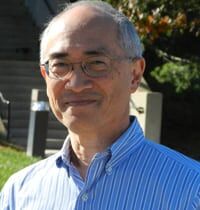
It’s hard to convey in a photograph just how big the headquarters of Lam Cloud Management really is. This summer the 10-person startup tech company moved into the former Aetna building on Farr View Drive in Cranbury. The five-story, 490,000 square foot building, seven times the size of the first Model T factory, was built in 1986 and served as a headquarters for a several insurance companies until Aetna moved out in 2008.
It has 10 football fields worth of floor space. Thousands of workers once filled its offices, corridors, atriums, conference center, cafeterias, gift shops, lobbies and lounges. Now most of the floors lie dark and empty. But where a visitor now sees empty space, Lam Cloud founder Lawrence Lam, a commercial architect by trade, sees vast potential.
Lam Cloud is re-imagining the corporate building as a multipurpose technology campus where clients can have all their IT needs met, from a data center (already up and running) to remote “virtualization” computing, to office space, to business continuity services.
The huge concrete and glass structure also offers something that many businesses became acutely aware of about a year ago when Superstorm Sandy knocked out power and travel: security. The campus, which has its own backup generator and uninterruptable power supply systems, didn’t lose power even during the storm. Lam Cloud’s disaster recovery services, offered in partnership with Agility Recovery Solutions, would have room for up to 4,000 people to work, with power, light, heat, communications, and food in times of disaster, when those commodities would be in short supply elsewhere.
Lam is eager to show off the facility to potential clients. The company is hosting an open house Thursday, November 14, from 2 to 6:30 p.m. at the building, which is located at 1 Farr View Drive in Cranbury. The open house will feature a guest appearance by technology author Andrew Blum (see box, page 5), as well as business continuity experts Marvin Wainschel of McWains Chelsea Inc. and Paul Sullivan of Agility Recovery Services. www.lamcloud.com. 888-936-5262.
But visitors probably won’t get to see the entire facility — it would take too long. The place is so large that Lam Cloud managing director Thomas Ryan still has to pause to get his bearings sometimes. “I’ve been here five months and I still get lost,” Ryan says.
There is plenty of room for what Lam calls “dark desks.” That is, desks with computers and telephones that sit unoccupied most of the time. But when emergency hits, if your company has a disaster recovery plan with LamCloud, you could light up those “dark desks,” move your staff there and continue business as usual as though you had a backup office.
Building the location into a technology center is a natural project for Lam, who has worked since 1982 as a commercial architect. Lam grew up in New York City, where his father ran car dealerships and his mother was a homemaker. Lam’s parents were born in China and moved to the United States to flee the turmoil of World War II and the Communist revolution. Growing up, Lam was enamored of technology. “I used to build shortwave radio sets. I just loved it,” he says. “I had the first IBM PC clone. It was a Packard Bell. I couldn’t wait to grab it off the shelf.”
But Lam decided not to become a technologist. Instead, he studied architecture at Columbia University, where he got an undergraduate degree in liberal arts with an architecture concentration, and then moved on to Yale School of Architecture where he earned a master’s degree. Since then he has designed a wide variety of commercial buildings.
As much as Lam loved architecture, he still felt the pull of technology. One fateful day in 2004, he went to a conference and ran into a man named Mike Castaneda, who ran data centers for large financial companies. The two talked about how companies manage information, and how many businesses were getting left behind in the rapid advance of technology. The two realized there was a market for a business that could help companies stay abreast of tech trends and stay competitive.
“It’s very hard for people to understand what’s out there and how to prepare when they don’t have the expertise,” Lam says. The concept took several years to coalesce, but by 2009 the two founded a company called Tier Management, with the idea that they would help bridge the gap between “tiers” of technology. Today Castaneda is the director of technology for the company. However, the “tier” buzzword soon faded, and in the spring of 2012 they renamed it Lam Cloud Management and signed a 25-year lease on the Aetna building.
Why clouds instead of tiers? And what, exactly, is the “cloud?” If you have been hearing the term “cloud” everywhere and are not sure what it means, you are not alone. “These days, the word ‘cloud’ seems to provoke debate,” Lam says. “Everyone has a different idea of what the cloud is. It means many different things. Some people are not comfortable with that, but we love the debate.”
Definitions of the appropriately ethereal word seem to revolve around offsite computing — that functions that appear on your desktop are actually taking place somewhere else; that your device is a portal to a larger world of computing power; and that if your phone or computer were to be destroyed in a flood, your data would still be out there, somewhere, in the cloud.
Lam loves the cloud image so much he has painted his building’s spacious conference center with pictures of clouds to give visitors the impression they are flying through the stratosphere rather than sitting in the middle of a farm field on the periphery of the U.S. 1 business corridor.
Initially, Lam’s plan was to turn the whole campus into a giant data center. But the vision of the company evolved as Lam did more research and discovered there were already many empty data centers available. Instead, he came to believe the site would support the mix of services that Lam is offering today, centering on business and business continuity.
Shortly after he decided to make business continuity part of his plans, Sandy hit. The building weathered the storm without a hitch. “This site is solidly engineered,” Lam says. “It’s pretty impervious to anything Mother Nature can throw at us and we’ve been strengthening it since we came in.”
The company will not only give customers a place to go, it will help them write plans for business continuity, whether that means just having a space with wi-fi where workers can bring laptops and cell phones, or having a locker full of software ready to go so that they could resume business as usual in a matter of hours. At the higher end, Lam Cloud can also duplicate an entire office and have it sitting ready at all times, which the customer could use even if there were no emergency.
A third aspect of the business is a program to serve as an “incubator” where startups can get cheap office space and access to Lam Cloud technology, so the “next 22-year-old Steve Jobs” with a bright idea has a place to get started.
And if Lam is successful, once that business gets started, nature itself couldn’t stop it. “We are going to keep you up and going no matter what. We have a plan ready to go, with heat, power communications and we offer access to computers,” Ryan says.